The Russell Model · Methodology

The Connected Coaching Framework.

Where knowing becomes doing.

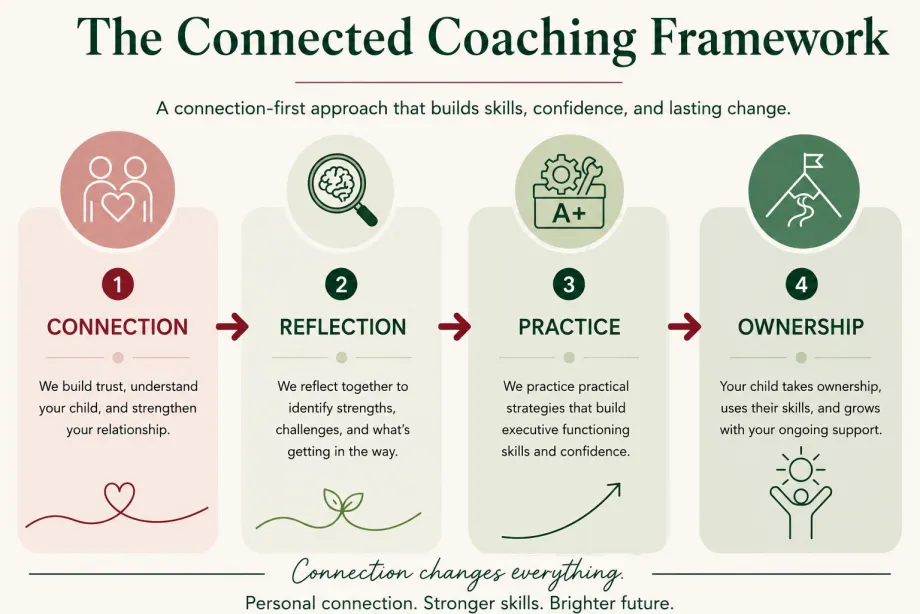
A connection-first approach that builds skills, confidence, and lasting change. Four stages, in order: connection, then reflection, then practice, then ownership. Every stage is built on the one before it, and the work doesn't move forward until the foundation is real. That's the whole methodology.

The framework

Four stages, in order.

The whole framework in one view — connection first, then everything that builds on it.

The Connected Coaching Framework — four stages: Connection (we build trust, understand your child, strengthen your relationship), Reflection (we identify strengths, challenges, and what's getting in the way), Practice (we practice strategies that build executive functioning skills and confidence), Ownership (your child takes ownership, uses their skills, and grows with your ongoing support).
01
Stage 01 Connection

Connection.

— we start here, every time.

Before we teach anything, we build trust. Your child has likely been talked at, tested, accommodated, and worked on by adults who didn't understand how their brain works. The first job is making sure they feel seen. We learn what your child cares about, what they're good at, what they're sick of hearing, and where they hide. The relationship is the foundation; the rest of the work happens on top of it.

02
Stage 02 Reflection

Reflection.

— before we change anything.

Once trust is real, we move through our assessment process together — looking at strengths, values, executive function skills, and study skills. Strengths get named so the student can build on them. Challenges get named without shame so we can solve them. We talk about what's getting in the way — at school, in the morning, at the desk, in the relationship with parents.

03
Stage 03 Practice

Practice.

— the skill-building stage.

This is where coaching looks like coaching. We pick a small number of high-leverage skills and run them weekly: how to start a task, how to break a project into steps, how to recover from a mess-up, how to ask for help, how to use a planner that the student actually wants to open. Skills get repeated until they hold up under stress. What's taught inside this stage: executive function, learning and study, and social & emotional skills — see below for details.

04
Stage 04 Ownership

Ownership.

— where the work compounds.

The endgame is your child running their own life — using the skills, leading their own meetings with us, telling their teacher what they need, recovering from a bad week without spiraling. You stay in the loop. We don't disappear. But the day-to-day driver shifts from us to them. That's the moment the work has actually landed.

A stressed student means a stressed family. Heal the student's skill set, and the whole stress loop unwinds. Our success metric is the family loop, working again.

— Dr. Russell.

Inside the practice stage

What we actually teach.

Stage 3 is the skill-building stage. Three categories run in parallel — every coaching plan is built around some combination of these.

Skill 01

Executive functioning

Organization, working memory, planning, prioritization, impulse control, emotional regulation, time perception. The brain's management system.

Skill 02

Learning & study skills

Note-taking, close reading, writing structure, test prep approach, how to actually use a planner. The how-school-works skills.

Skill 03

Social & emotional skills

Self-regulation, self-advocacy, communication, recovering from setbacks. The skills that decide whether the rest of it sticks.

Boundary

What coaching is not.

Not therapy. Coaching can be deeply therapeutic — kids gain confidence, calm, agency — but we're not psychotherapists, and we won't pretend to be.

Not tutoring. We help with note-taking, close reading, writing, and study skills, but the goal is the underlying executive function, not the algebra homework.

Not insurance-billable. Coaching is not covered by insurance. It is covered by several state scholarships — see the scholarships page if your state qualifies.

Connection changes everything.

Personal connection · Stronger skills · Brighter future

— see if it fits —

Start with a free call — before anything else.

Free 30-minute call. We tell you honestly whether Connected Coaching is right for your student — and what to try if it isn't.

Schedule a complimentary call